
OVER 100 PERSONS WITH DISABILITIES BENEFIT FROM POULTRY FARMING INITIATIVE UNDER ECO FOOD PROJECT IN ADJUMANI
By Herbert Yiki
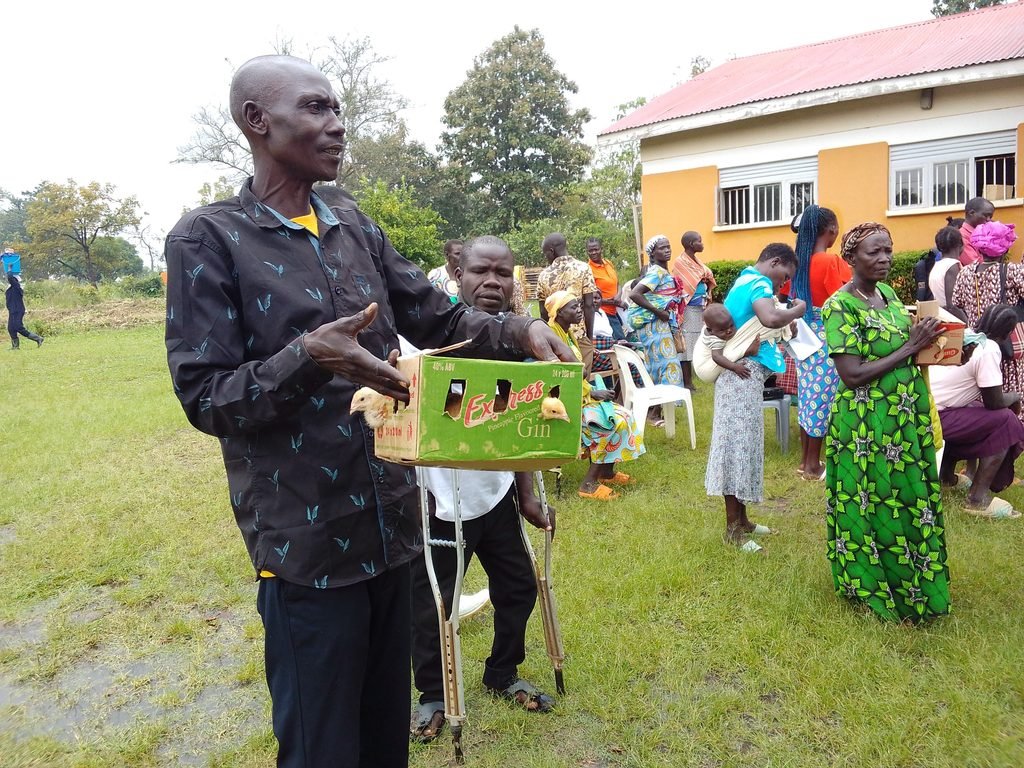
More than 100 persons with disabilities (PWDs) in Itirikwa Sub-county, Adjumani District, have benefited from a poultry farming initiative under the ECO FOOD Project, aimed at improving household food security, increasing incomes and promoting disability-inclusive agricultural development.
The intervention, launched in early 2026, supports persons with disabilities and other vulnerable communities to participate in sustainable and climate-smart agricultural activities while improving their access to livelihood opportunities.
Through the distribution of chicks, individual beneficiaries are being equipped to engage in poultry farming as an alternative source of household income and nutrition. The initiative is expected to enable families to consume eggs and poultry while selling surplus produce to generate additional income.
The ECO FOOD Project promotes sustainable, climate-smart and disability-inclusive agri-food value chains across Northern Uganda.
It is coordinated by Christian Blind Mission (CBM) and implemented through a consortium comprising the National Union of Disabled Persons of Uganda (NUDIPU), Community Empowerment for Rural Development (CEFORD), Cooperation and Development, AgriTalk and the East Africa Entrepreneurs Association (EAEA), among other partners.
The project is funded by the Italian Ministry of Foreign Affairs and International Cooperation through the Italian Agency for Development Cooperation (AICS).
Combining Poultry and Vegetable Farming for Better Livelihoods
Beyond poultry farming, the ECO FOOD Project is promoting vegetable production, particularly crops such as dodo, to diversify household food sources and create additional income-generating opportunities.
Beneficiaries are encouraged to grow vegetables for household consumption and sell surplus produce in local markets, helping improve nutrition while reducing dependence on a single source of income.
By combining poultry and vegetable farming, the project seeks to strengthen household resilience, improve food availability and create sustainable livelihood opportunities for persons with disabilities.
Promoting Ownership and Sustainability
Speaking during the engagement, Mwangaike John, a board member of the National Union of Disabled Persons of Uganda (NUDIPU), emphasized the importance of beneficiary ownership in ensuring the sustainability of the interventions.
He urged persons with disabilities to take responsibility for the project rather than depending entirely on implementing organizations to sustain the initiative.
“We should own this project; it is no longer for NUDIPU,” he said.
Mwangaike also encouraged beneficiaries to organize themselves into groups to strengthen their participation in agricultural activities and improve their access to development programmes and livelihood support.
Meanwhile, Musinguzi Julius, Programme Head at NUDIPU, highlighted the project’s commitment to promoting sustainable, climate-smart and disability-inclusive agricultural value chains.
He called on government leaders at all levels to ensure that persons with disabilities are deliberately included in government programmes and development initiatives.
He emphasized that equal access to economic opportunities, agricultural resources and livelihood support is essential to ensuring that persons with disabilities participate meaningfully in community development.
Beneficiaries Look to Improved Household Incomes
For beneficiaries, the poultry initiative offers an opportunity to improve their livelihoods and become more economically independent.
Mundua Scovia, a member of the Hope of Future Group in Aliwara Village, Mungula Parish, welcomed the support, pledging to make productive use of the resources provided through the project.
She said the poultry intervention would help her improve household income and food security while creating opportunities to strengthen her family’s economic well-being.
Scovia expressed hope that the different interventions under the ECO FOOD Project would bring lasting improvements to her livelihood and enable her to become more self-reliant.
District Reaffirms Commitment to Disability Inclusion
At the district level, Hon. Ambayo Godfrey Chono, the district councilor representing persons with disabilities, reaffirmed his commitment to advocating for the inclusion of PWDs in local government development programmes.
He noted that persons with disabilities require deliberate support to access livelihood opportunities and benefit from government interventions aimed at improving household welfare.
Ambayo also pledged to continue advocating for disability-related priorities that remain inadequately funded at the district level, calling for greater attention to the needs of persons with disabilities in planning, budgeting and service delivery.
Reaching More Vulnerable Communities across Northern Uganda
The ECO FOOD Project is designed to benefit more than 6,100 people across Northern Uganda.
At the grassroots level, the initiative targets 1,108 marginalized individuals from 221 households, organized into 37 district farmer groups or cooperatives.
Disability mainstreaming is one of the project’s key pillars, with NUDIPU playing a leading role in ensuring that persons with disabilities are included in agricultural value chains and have opportunities to benefit from livelihood improvement interventions.
Through poultry farming, vegetable production and other agricultural interventions, the project seeks to address barriers that have historically limited the participation of persons with disabilities in economic activities.
For beneficiaries in Itirikwa Sub-county, the distribution of chicks represents an opportunity to improve household nutrition, generate income and participate more actively in community economic activities.
The long-term impact, however, will depend on beneficiaries’ ability to sustain the enterprises, access markets and receive continued technical support.
END