
WEAK ENFORCEMENT FUELS RISE OF SUBSTANDARD GOODS IN WEST NILE
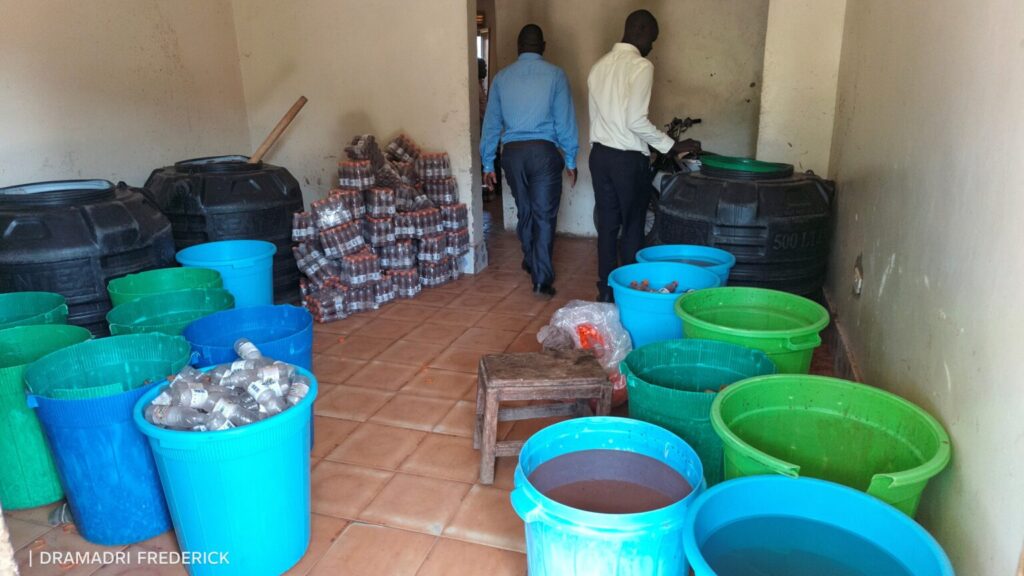
Arua City Health Authority seized 662,000 liters of illicitly produced alcohol early 2026 in Ayivu Division from Juas Enterprises Limited, Jack and Donatha Partners, unlicensed companies due to failure to follow laws.
By Dramadri Federick
Poor enforcement of laws and the increasing production and sale of substandard and counterfeit goods by micro, small and medium enterprises (MSMEs) are undermining consumer rights in Uganda’s West Nile region.
According to the Ministry of Finance, Uganda has about 1.1 million MSMEs, accounting for nearly 90 percent of the private sector and employing more than 2.5 million people.
The ministry notes that, most of these MSMEs operate largely in the informal sector, generating about 80 percent of the country’s manufactured output and making a significant contribution to the economy.
However, the growing trade in illicit and substandard alcohol for export is undermining Uganda’s economic reputation among neighboring countries that consume some of these products.
Silas Anguzu, the Chairperson of the Uganda National Chamber of Commerce and Industry (UNCCI) Arua City Branch, said, several consumers of substandard products in West Nile have died due to weak enforcement and poor compliance with standards.
He added that some MSMEs are venturing into the export of goods to Democratic Republic of Congo or South Sudan without meeting required standards, putting the lives of consumers in the neighboring countries lives at risk.
“The best would have been for Uganda National Bureau of Standards (UNBS) to come and establish offices here in Arua city for West Nile region but we have been crying for this in vain. It is very saddening to see a pick up vehicle coming here all the way from Gulu to arrest 10 weighing scales and they go back. This is opening the door to extortion and fraud other than helping our businesses to abide by the laws,” Anguzu explained.
In August 2022, 17 people died in Arua City and the neighboring Madi-Okollo District after consuming a locally produced gin known as “City 5,” manufactured by Luluwiri Fruit Wine Company. The drink was found to be contaminated with high levels of methanol.
Investigations by the Uganda National Bureau of Standards (UNBS) revealed that the gin had been adulterated with methanol, an industrial chemical sometimes used as a substitute for ethanol to increase the potency of alcoholic products.
Legal frameworks such as the UNBS Act (Cap 327), which promotes quality assurance, standardization of commodities, and enforcement of standards to protect public health and safety, and the Weights and Measures Act (Cap 84), which ensures fairness in trade by regulating the accuracy of weighing and measuring equipment, are increasingly seen as ineffective due to weak enforcement.
Victoria Namutebi, Senior Communications Officer at UNBS, attributes the persistence of counterfeit and substandard goods on the market to low staffing levels, which continue to hinder effective enforcement across the country.
“We expected to develop 7,778 standards per year but currently we have only 4000 standards developed and this is due to low staffing, we need to decentralize our services further, we only have an office in Gulu and a laboratory for investigations in Lira for northern Uganda. Someone has to travel this long distance from West Nile to Gulu for the services that means we need a lab and office in Arua,” Namutebi suggested.
Despite registering 73.9 billion shillings in non-tax revenue, surpassing its target of 54.4 billion shillings, UNBS currently operates at only about 40 percent of its quality assurance capacity.
The bureau has 538 staff, far below the approved structure of 1,200 personnel, creating significant enforcement gaps. In the 2024/2025 financial year, the agency seized 1,264,896 kilograms of substandard products, a sharp decline from the 11,177,223 kilograms seized in the 2023/2024 financial year.
Praxeda Ndagire, Projects Focal Person at TradeMark Africa, said many counterfeit goods enter the country through porous border points.
However, she noted that the organization is working with partners to ensure that goods traded across borders meet the required standards.
“We have engagements with UNBS in terms of establishing labs where they want us to do so that whatever is produced and exported meets the standards,” Ndagire revealed.
Meanwhile, UNBS reports that, during the 2024/2025 financial year, the bureau handled 30 civil cases, while 95 criminal cases were recorded related to breaches of standards and metrology laws.
END.